
Description
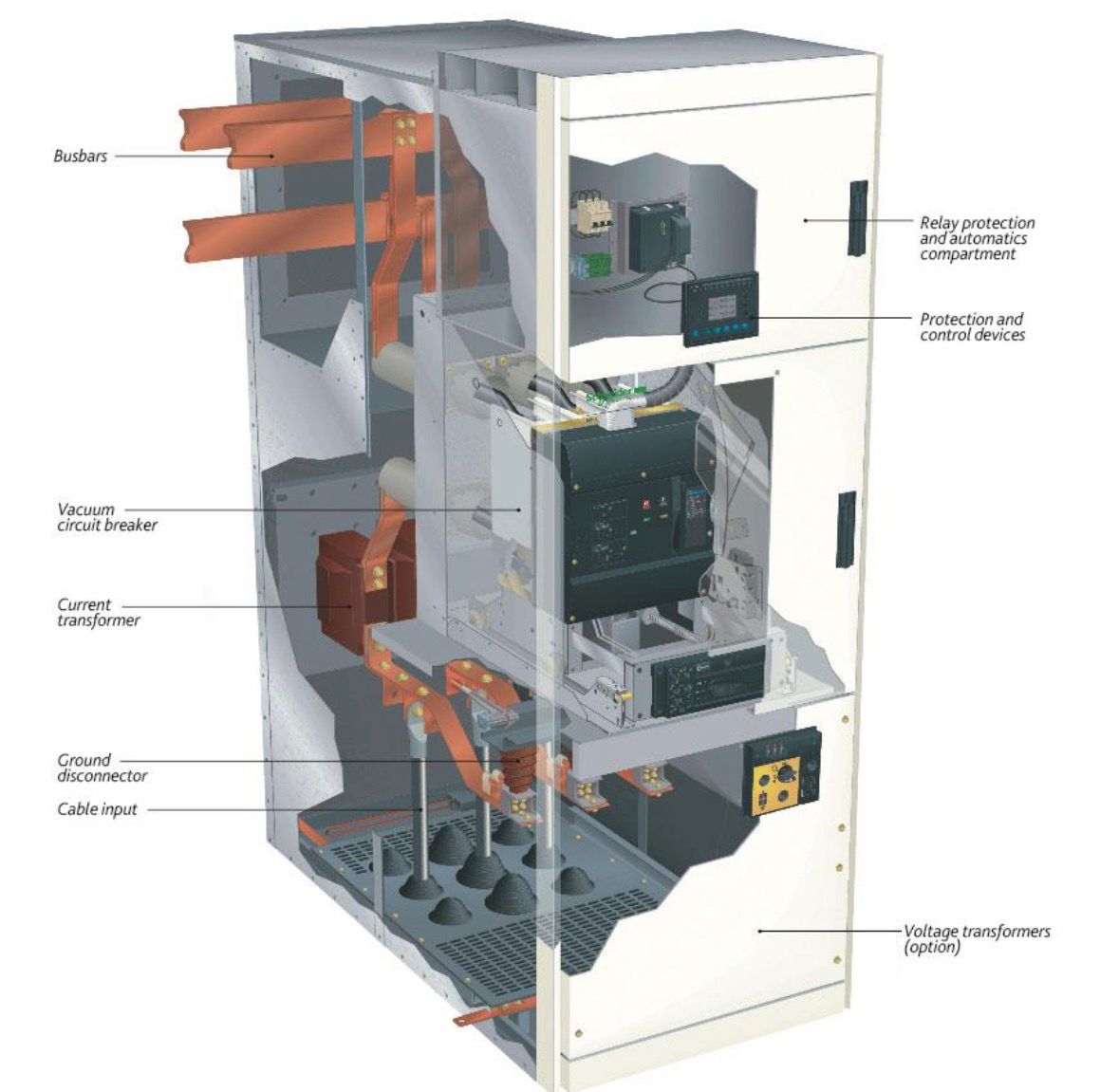
A Medium Voltage (MV) Panel (also called MV Switchgear) is used to receive, control, protect, and distribute electrical power at voltages typically ranging from 1 kV to 36 kV. In India, the most common MV systems operate at 11 kV, 22 kV, or 33 kV.
MV panels are installed between the utility power supply and the transformer, where they safely switch and protect medium-voltage electrical networks.
Main Functions
* Receives power from the utility or substation.
* Controls switching operations.
* Protects equipment from short circuits, overloads, and earth faults.
* Isolates faulty sections for maintenance.
* Distributes power to transformers and large industrial loads.
Main Components
* Vacuum Circuit Breaker (VCB) – Main switching and protection device
* Isolator / Disconnector
* Earth Switch
* Current Transformers (CTs)
* Voltage Transformers (VTs/PTs)
* Protection Relays (Overcurrent, Earth Fault, Differential, etc.)
* Busbars
* Metering Instruments
* Trip Circuit
* Control and Protection Wiring
* Cable Compartments
Types of MV Panels
* Incoming Panel
* Outgoing Feeder Panel
* Bus Coupler Panel
* Transformer Feeder Panel
* Motor Feeder Panel
* Capacitor Feeder Panel
* Ring Main Unit (RMU)
Typical Specifications
* Rated Voltage: 3.3 kV, 6.6 kV, 11 kV, 22 kV, 33 kV
* Frequency: 50 Hz
* Rated Current: 630 A, 1250 A, 2000 A, 3150 A
* Short-Circuit Breaking Capacity: 25 kA, 31.5 kA, 40 kA
* Insulation: Air-insulated (AIS) or Gas-insulated (GIS)
* Protection: IP4X or higher
* Standards: IEC 62271 Series
Advantages
* High operational safety
* Reliable fault protection
* Compact and modular construction
* Easy maintenance
* Suitable for industrial and utility applications
* High switching endurance with VCBs
Applications
* Industrial plants
* Electrical substations
* Power generation plants
* Commercial complexes
* Data centers
* Mining operations
* Steel, cement, and chemical industries
Reviews
There are no reviews yet.